
It was an experiment I didn’t mean to happen.
When I first published the article back in 2018, the Medium Partner Program was open to everyone despite their following status. All you had to do was sign up for it with Stripe, which I did, earning my pennies every month while not paying too much attention to it.
Only recently have I rediscovered Medium and noticed one of my articles actually did pretty well just sitting here without much love from me. Here it is:
Actually, this is a piece I wrote for a client that was rejected. In hindsight, I’m grateful to have this article/guide as my own. If you read it you’ll see I put a lot of work into it, especially considering I didn’t know a lot about fishing in the winter on the Oregon Coast (I can barely catch a fish in a stocked pond).
At this point you may be asking, how popular could this article have been?
Well, when you get to the thousands of views, I guess the hundreds, tens, and ones aren’t as important with Medium’s stats, so I’m limited in saying an estimated 1,400 views, or 1.4k, as they put it.
Maybe not a celebrity status work here, but remember I cruised along for 4.5 years with just 33 followers at the peak (raised to 48 after coming back).
- 14 internal views
- 10 min 35 sec member reading time
- 99% of views were from external referrals
- 1.2k from Google.com
- 2 min 12 sec average reading time
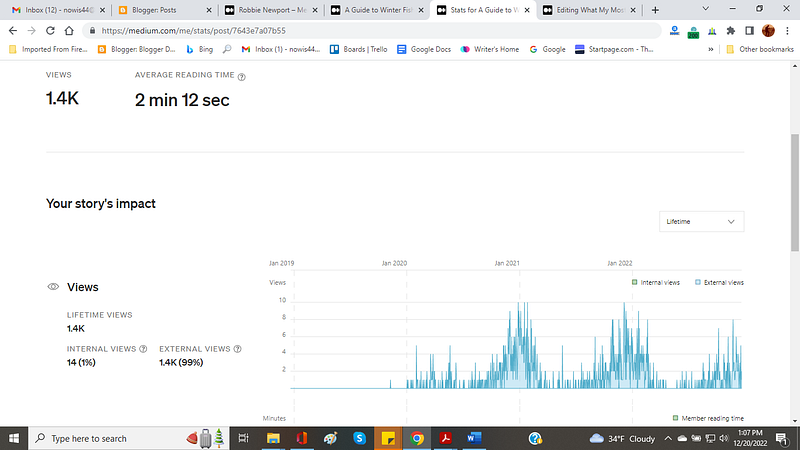
You can also see the graph, how it repeatedly gets more popular during the winter. That makes sense concerning the content, of course. You can also see that it is 34 degrees today around 1 pm, which is sort of warm for this time of year in Eastern Oregon.
Lesson #1
What all this tells me is my article did poorly at Medium, yet well in organic SEO.
Now, this article is also published on the blog correlated with this account, Business and Society Articles. Looking up winter fishing on the Oregon Coast, the Medium article came up 1st on Google while my blog article came up 15th.
See, I didn’t import that article over to Medium, nor did I enter the canonical link manually afterward (until just recently).
What this tells me is even if you don’t enter the canonical link, both will still show up, yet Medium will be rated higher in organic search.
This may seem like a no-brainer considering the domain rank, yet it shows me that duplicate content doesn’t hurt the article enough to knock it out of the search results. I mean this article is ranking first, so Google doesn’t care so much about duplicate content, even though the blog version was published first — the Medium article did always contain a reference link at the bottom.
Lesson #2
I was pondering writing solely on Medium and sort of abandoning my blogs at some point recently, yet this would be a bad idea because my most popular article here only earned 14 views and around 2 minutes of reading time!
This makes sense considering I wasn’t active on Medium; I was a post-and-go type with very few followers, etc.
Still, even with thousands of followers, I can’t see articles like this doing very well here with members. This tells me I need to write on my blogs and syndicate the content with the import link.
I don’t even care which article shows up highest in the search as long as one of them does, and it doesn’t seem to hurt that both of them are out there.
Lesson #3
Now I have to consider that this article has never been metered, so non-members had full access to it. This may have helped it be ranked higher and/or helped it become more popular with readers.
If I become a Medium Partner once again when I reach 100 followers, then there will be a paywall up for non-members who have reached their limit of 3 articles per month.
This means more visitors are likely to sign up for Medium through my referral link. If my blog article is more popular then my email list is more likely to grow.
Either way, it works out well, as long as the article gets traffic.
Even though the blog article was ranked much lower in the search, it still is the third most popular article on my blog out of 27 articles. Blogger says it has had 2.8k views, but from experience using Google Analytics these equal about a tenth in actual users/visitors — so maybe around 280 visitors.
Would this article have done as well in search if it wasn’t on Medium? Probably not. I could safely say Medium helped me get hundreds of visitors I wouldn’t have had otherwise.
Conclusion
The main lesson I learned from my most popular article on Medium is don’t just write on Medium. Write on my blogs and then import them over. The search engines won’t penalize me to the wastelands for syndicating content on either site (even without a canonical link).
As for getting internal views from members on Medium? Well, this takes a lot of work on this site, building an audience, writing hundreds of articles, and networking with publications. It also takes writing the type of articles that are popular on this site, including articles about this site, making money writing, and making money online in general.
I’m sure there are some creative and journalistic types making money here too, but from what I’ve gathered, the big money here is made mostly by trendy types who write about money, being successful, and generally being an influencer; at least the type of money to make a living with.
Still, Medium is a great place where all types of writers are welcome to earn some money, make friends, be part of a quality writer’s community, share their talents, and build their presence for other ventures.
Hopefully, by examining this article, I’ve helped you understand in some measure how Medium works and how it can work for you. Until next time, I’ve gone fishing.

Comments
Post a Comment